Showing posts with label Reading. Show all posts

October 25, 2011

Reading Comprehension Strategies


Helping New Readers Find Meaning 

Assisting new readers with reading comprehension is an important role for parents, caregivers, and other volunteers who work with children at the kindergarten through 2nd grade level. Many children this age are emergent readers who are just beginning to put meaning to text. Much of their comprehension skills will be developed as they listen to stories read to them. Other children this age will be reading independently and forming personal comprehension strategies.

Whether you are reading aloud to a whole class, or working one-on-one with an independent reader, it is important to check for comprehension and promote strategies that will assist the student with finding meaning among the words.

Below you will find four strategies you can use to assist learners with reading comprehension skills. Following a description of each, you'll find a suggested method to introduce the strategy, demonstrate it, provide the student with practice, and assess their learning. These are not the only methods to implement these strategies, and these are not the only strategies, but they are a great beginning to your tool-box. As you refine these tools, remember, every child is different and will have different needs. You may need to use only one of these strategies, or you may need to use them all and others as well. Always put the child before the strategy and have fun as you encourage their joy for reading.

1. Set Expectations

If you are assisting a reader with comprehension, first set up his expectations for what he is about to read. By doing this, the reader is more likely to become engaged in the words and observe details. To do this, simply determine what information you want the reader (or listener) to gain from the reading. Keep in mind that this is a pre-reading step and be cautious to not spoil the plot. Use the following to guide you as you set expectations:
  • Prior Knowledge - What does the student already know about the subject? Has she read or listened to similar stories? Does she have any first hand experience? For instance, if the student is reading a book about Oregon and has been there on vacation, she can tie prior knowledge to the book's content. Or, if she is listening to a story such as Charlotte's Web by E.B. White, she may already know what kinds of animals live on a farm.
  • Browse the Content - Whether its a book, a newspaper article, a web page, or another source of text, browsing the content can provide significant comprehension clues. Look for things such as the title, the author, illustrations, charts, etc. With well-known authors you can ask, "Do you think this story be like the other one we read by...?" Dr. Seuss is an excellent example of such, with readers likely to expect rhyme. Though rhyme has little to do with comprehension, it does let the reader know that they will not have standard sentences and paragraphs from which to glean knowledge.
Be careful not to give away the details of a story or text prior to reading it by asking too many questions. Discovering the who, what, when, where, and are why should something we expect with most everything we read. However, these questions should be activated while reading and not prior to.

Setting expectations is a strategy that can also be taught to students as a tool they can use on their own. You can provide them with a graphic organizer to fill in details such as author, title, and key words.
Or teach them to ask themselves questions such as:
  • Have I read anything else by this author? 
  • Do I already know anything about...? 
  • What do I expect to learn from this story or passage?
Put it to Work
  1. Introduce: With an independent reader, introduce the concept by setting before them a book they are unfamiliar with (ensure it is the appropriate reading level). Tell them that before they begin reading, you would like them to get to know the book. Explain that they will do this by looking for clues as to what they story is about.
  2. Demonstrate/model: Use a My Turn, You Turn activity to set expectations about the books content. place a list of appropriate questions in front of the student. Explain to the student you will say "My turn,"  followed with a a question about the book, such as "My turn. Have I read anything by this author before?" Then answer your own question. When you are done, say "Your turn."
  3. Practice: During the students turn, have them phrase a question in the same manner, starting with "My turn," asking a question, answering it, then signalling they are done by saying "Your turn." Repeat this activity for 2-3 turns or until you are satisfied with the student's discoveries. 
  4. Assessment: You can assess the student informally during the activity as they ask and answer appropriate questions. To further check for understanding, you can present he reader with another book and have them answer the questions on their own, either in writing or verbally. 

2. The Five W's and the H

Once we step into the text we need to be considering the a lot of questions in order to find meaning. This is where comprehension often becomes tricky for some readers, and listeners. At a very basic level, we could ask:
  • Who is this story about? 
  • What is happening? 
  • When did it occur? 
  • Where does it take place? 
  • Why is that important?
  • How does the story end?
With more advances students, other questions can be asked to invoke higher level thinking, such as:
  • Who is the author writing to?
  • What can I do with this knowledge?
  • Why did the author write this?
  • How could we change then ending?
If you are reading a story or text aloud, you might check for comprehension by asking:
  • What do you think we will read on the next page?
  • Why do you think he felt/acted that way?
Put it to Work
  1. Introduce: With an independent reader, introduce the Five W's and H with a simple activity describing  the room or environment you are working in. For instance, you might say, "Today we are going to use the Five W's and H strategy to learn about our book. These are the who, what, when, where, why and how questions we can ask when we are describe something. For example, Who is in this room? We are! What are we doing? Reading a book. When is it? After school. Where are we? The library. Why are we doing this? To become a better reader. How many books will we rad today? One. Does this make sense?"
  2. Demonstrate/model: Explain to the student that the same types of questions can be used while reading. Demonstrate by opening a book and reading a paragraph or two. Then ask the same questions, this time allowing the student to answer. 
  3. Practice: Ask the student to read the next paragraph or page and then create, ask, and answer a set of who, what, when, where, why and how questions. Assist as needed. 
  4. Assessment: Assess the students informally with open discussion and probing questions such as, "Can you think of another how question we can ask for that page?" or "What did you learn by asking those questions?"  
Remember, that when working with children at the kindergarten - second grade level, or any grade level for that matter, their abilities for reading, listening, and communicating will vary greatly. If the planned comprehension activity seems too difficult for a given group, then simplify it. You can instead have the students fill-in a one-word blank in a pre-written sentence.

For higher level students, you can teach readers to ask these questions for themselves by having them write out 5-10 w/h questions and answers as they read. A nice twist to this is to have students 'Write the test.' Simply have them write the questions they think should appear on a test of the text. If working with a group, the readers can ask each other their questions. Or, as appropriate for the level of the students, you can select several of the questions to ask the group as a whole.

3. Get to Know the Characters

Understanding the people we read about is an important part of our comprehension skills. This can be applied to both fiction and non-fiction. Does the reader have anything in common with a character? Or, does the character or subject of a text remind them of someone they do know? For instance, one reader might want to be just like a character from the American Girl series. Another reader may think Jane Goodall looks a lot like his grandmother. What ever the connection is, making such will help the reader recall the characters.

A fun way to get readers thinking in this manner is to have them design a poster or other illustration that shows a relationship between someone they are reading about and someone they know. This can be done free-hand or with the assistance of graphics software, and can be as simple as a pencil drawing or fully elaborated with color, with results such as:
  • My Knuffle Bunny,  a picture of the child's own favorite stuffed animal they just can't be without.
  • My Dad IS Albert Einstein, a poster with pictures of each and arrows pointing out the same hair and manner of dress 
  • Ramona is my Long Lost Twin! an illustrated list of traits the reader has in common with this well known character created by Beverly Cleary 
Put it to Work
  1. Introduce: When working with emergent readers who are listening to a story read aloud, explain that often the characters in books remind us of ourselves or other people we know. Explain that as you read a new book to them, you would like them to think if any of the character have something in common with someone they know. Carefully select a book that includes a variety of characters, or has a character the same age as the student(s). One good choice might be the stories found in Little Bear's Friend by Else Holmelund Minarik. 
  2. Demonstrate/model: After reading a story, relate one of the characters to yourself or someone you know. For instance, "Emily reminds me of myself. I really like cookies."
  3. Practice: Ask the student if any of the characters remind them of someone they know or themselves. Have them explain why. Then have them draw a picture of the character and the person. Have the student label the picture, assisting as necessary. 
  4. Assessment: To informally assess if this activity has aided the reader in better understanding the characters in  the story, you can probe the reader with comprehension questions that include the person they know. For example, if a student were to have given the model example above, you could say "Do you and Emily have anything else in common?" or "Would you have shared your cookies with Little Bear?"

4. Visualize


When the reading is done, the reader (or listener) should be able to visualize the content learned. Can they imagine the scenery in Oklahoma when reading a book such as Out of the Dust by Karen Hesse? Or, on a younger level, can they visualize the dangers that surrounded Robert McCloskey's web footed friends in Make Way for Ducklings? Can the reader of a science text book visualize the process of evaporation?

Visualization not only occurs at the end of reading, but also during, particularly when there are large chucks of important material presented. If several facts or a series of events were presented together, take time to journal a list of these with descriptive details. A reader may also want to make a sketch or diagram of a procedure or a process. If two characters in a novel are quite similar, one may want to visualize just how they are different and perhaps sketch them out in a notebook, summarizing each character traits to lessen confusion between the two.

When comprehension is not observed at this level, a reader can always back-up and look for clues. Finding key adjectives and adverbs will often assist with visualizations. Making a list of such while reading is a good way to begin the habit of zeroing in on these and discovering their power.

For instance, take a look at the bold text adverbs and adjectives in the following passage.
  • It was a cold, damp morning when Vince hastily headed off to school down the crowded sidewalk. He could smell the crisp bacon, sweet maple syrup and warm pancakes on one passerby. Another smelled of hot coffee and perhaps a fresh egg sandwich. With every step his stomach churned, but his determined stride kept him moving forward. No one in his neighborhood could know.
After reading such a passage, a reader might be left wondering "could know what?" By looking at the adjectives cold, damp, warm and hot one could infer that he had no heat at home. Vince's detailed awareness of what others had for breakfast, combined with his churning stomach, could also mean he had no food at home. We also know he was moving hastily and determined. By making these observations we can begin to visualize where the story takes place and where Vince lives. Granted this is not the whole picture, but it is a start.

For readers who struggle with understanding why adjectives and adverbs are important, replace them in a passage to see what happens. This will often turn into a silly story, but open up a great discussion on the power adjectives and adverbs hold when we are reading for comprehension.
  • It was a hot, dry morning when Vince lazily headed off to school down the quiet sidewalk. He could smell the burnt bacon, fake maple syrup and day-old pancakes on one passerby. Another smelled of stale coffee and perhaps a cheap egg sandwich. With every step his stomach churned, but his contented stride kept him moving forward. No one in his neighborhood could know.
Is Vince without food in this passage, or are those he is passing causing his stomach to churn? Adjectives and adverbs, though often small, are without doubt keys to successful reading comprehension strategies.

Put it to Work
  1. Introduce: With an independent reader who has already learned what adverbs and adjectives are, review the purpose of such words. Explain to the student that you will be learning how these words impact the way we visualize a story. 
  2. Demonstrate/model: Present the reader with a descriptive passage containing highlighted adjectives and adverbs, such as the one above. Read the passage and then discuss the scene you visualize. Then replace the adjectives and adverbs and discuss how the image of the scene has changed.
  3. Practice: Allow the student a turn to again change the adjectives and adverbs of the same passage, or present them with another passage. Have them describe what they now visualize the scene to be.
  4. Assessment: To check for understanding, have the student explain why adjectives and adverbs are important to a story. Then have them read another passage and use the adjectives and adverbs to describe the scene. If appropriate, they can illustrate the passage as well. 

Wrapping it Up

There are a lot of methods and strategies to consider when assisting learners with reading comprehension strategies, many more than you'll find listed here. Always remember, the only true way for a reader to display comprehension is with communication. This can be in verbal conversation, journaling, illustrating, etc. A simple, "Yeah, I get it." is not enough. Use the strategies above to help a reader find meaning in the words, and be sure to allow plenty of time for discussion and exploration. When one of your tools does not work, try another. Above all, never forget that every learner is different and above all, strive to develop readers who enjoy the reading.


References:
Berry, J. (1988). A children's book about being greedy. Danbury, CT: Grolier Enterprises Corp. 
Cleary, B. (1981). Ramona Quimby, age 8. New York, NY: Harper Collins. 
Goodall, J. (1996). My life with chimpanzees. New York, NY: Aladdin / Simon & Schuster. 
Hesse, K. (1999). Out of the dust. New York, NY: Scholastic, Inc.
Kurtz, J. (2009). Lanie's real adventures. New York, NY: American Girl Publishing, Inc.  
Lowry, L. (2002). Gooney Bird Greene. New York, NY: Random House. 
McClosky, R. (1941). Make way for ducklings. New York, NY: Penguin Books.
Minarik, E.H. (1960). Little Bear's friend (1996 ed.). New York, NY. Harper Collins. 
Pearson Education. (2006). Scott Foresman science grade 1 (Diamond ed.). Upper Saddle River, NJ: Pearson Education. 
Seuss, D. (1963). ABC. New York, NY: Random House 
Winterfeld, H. (1956). Detectives in togas. Orlando, FL: Houghton Mifflin Harcourt Publishing. 
Wishinsky, F. (2005). Albert Einstein (DK biography). New York, NY: DK Children / Penguin Group.
White, E. (1973). Charlotte's web. New York, NY: Harper Collins. 


Post ID: WGU REAT9

September 30, 2011

The Six Language Arts Skills

With each passing year, language arts have allowed mankind to thrive and to reach greater levels of knowledge and productivity. You often here mathematicians and scientists credited with such accomplishments, but what if those innovators could not read? What if they could not write or otherwise clearly communicate their ideas? How could they promote their ideas or share their advancements with others? No matter what specialty one excels in, a proficiency in language arts is the key to further cultivation of skills, talents, innovation and success.

Language arts development in elementary aged children includes all skills related to reading, writing, speaking, listening, viewing, and visually representing ideas and knowledge as designated by the National Council of Teachers of English (NCTE) and the International Reading Association (IRA) (1996).
“These six areas are notably different from one another, but there are also important connections among them… reading and writing involve written language, listening and speaking involve spoken communication, and viewing and visually representing involve visual language.”
These skills are all part of effective communication, and though some go through life deficient in one or more of these areas, the best communicators learn to use them all efficiently. For this reason, it is important we incorporate all six areas into elementary language arts instruction.

By this point in a child’s life, he has some life experience to help him make sense of oral, written, and physical forms of communication, though for every child this background knowledge is different. Perhaps one child had great exposure to sign language is his early years, while another spent most of his time watching TV. Another may have listened to a great variety of books and music, while still another had nothing more to listen to than the conversation of those around him. Whatever the case me be, it is important to reach each child at their level and provide them with opportunities to explore all areas of language arts as often as possible.

Reading

When it comes to the systems of symbols and markings we know as writing, there really is no reason or rhyme or reason to it except that one group of people started using it and others continued to refine and define it until it got to where it is today. The basis of learning to read is nothing more than learning to decode the message represented by such symbols, but reading does not stop there. Reading also involves understanding and comprehension, knowing what each individual word means, and how they work together to form a sentence, a paragraph, a story, and a book. It also includes interpretations of purpose and meaning, such as knowing whether a book was written to teach a moral lesson or written to teach one how to cook. At the elementary school level, these skills are just developing, and thus a crucial time for matching children’s skills with texts they find interesting in order to encourage a desire for reading proficiency.

Writing

The bunch of lines and squiggles on paper, or another medium, to create letters is what most think of when we talk about teaching elementary aged children to write. Yet, this is a small piece this very critical area of language arts proficiency. Not only do children need to know how to form letters and make words, they need to learn how to use these words effectively and clearly to communicate their ideas and thoughts to others. This involves an understanding of spelling and grammar rules, sentence and paragraph structure, style and voice, and other complexities that have come to make our language richly diverse and interesting. For today’s elementary aged child, this skill also takes on a great deal more than paper and pencil handwritten assignments of yesteryears. It often involves word processing software, touch screens, interactive smart boards, and other technologies that have reduced a need for developing refined handwriting prior to the ability to express ones thoughts and ideas with written words.

Speaking

In order to develop meaningful speech, children need to learn how to use emotion, volume, tone, and inflections to fully communicate the meaning of their words. This skill often comes naturally while listening to others, but not always. In some cases elementary aged children need to be taught this skill, particularly when they are reading aloud because they are often focused only on the recognizing the words and not the meaning behind them. Also at the elementary level, children quite often need instruction in understanding time and tense as they learn to communicate when an event or story took place. It is not at all uncommon for a child of this age to talk about a party from a year ago as if it were happening today. This of course can be confusing to the listener. Rounding of this language arts skill, a well developed vocabulary makes speech communication more effective and efficient. Thus, at the elementary level, it is important that children continue to receive diverse experiences and exposures that will increase the word bank in their developing minds.

Listening

For most people, this is the first of the language arts skills we learn to develop. Before we can see clearly, before we can speak, and before we can gesture for things we desire, we are learn to listen for clues about the world around us. Newborn babies today hear others speaking, they hear the sounds of nature, and they hear the sounds of technology all around them. Unfortunately they quite often learn to tune out much of what they hear and to selectively receive and process what they desire to fulfill their basic needs. When they enter the elementary ages, however, it is important that children learn to process what they are hearing for deeper meaning and purpose. It can be quite difficult for some to learn what to ignore and what to pay attention to, and even then what to do with the information they heard. Still, such skills are crucial to learning content and should receive considerable attention during the elementary school years. Reading aloud to children and asking comprehension questions is a great way to improve their listening skills. Having children complete an activity while listening to audio stories and music selections is also helpful. Activities could include putting character cut-outs in the order they hear them presented, or sculpting images of what they think they are listening to. Other strategies include rewarding good listening habits, such as giving a sticker to all the children who put way their books as soon as they are told.


Viewing

The skills involving observation and interpretation are all included within the category of viewing, whether one is watching television, studying a photograph, or looking at a chalk art on a sidewalk. Today, the visuals that surround elementary aged children are far more plentiful than those just twenty years ago, and nearly every moment there is something new available for them to look at. It is important to help young children learn to observe these images critically, process the content, and comprehend the meaning. This may sound complex, but it starts with simply asking what the purpose is behind what one is looking it. Is it advertisement? Does it want to convince others of something? Is it just to tell a story or to entertain? Teaching elementary aged children to consider such questions will set a firm foundation for the critical thinking skills they will need when they reach more complex content and higher levels of learning.

Visually Representing

Naturally on the other side of viewing we find the creation of collages, posters, photographs, dramatizations, videos, charts and graphs… to some this may seem like the most advanced of all the language arts sub-areas, but really it can be the simplest. Stick drawings and crayon pictures can be far easier to make and interpret than letters and symbols one may be unfamiliar with. For this reason when we study ancient history we find it far easier to understand cultures that recorded their stories with pictures rather than those who used letters or other such text symbols. Thousands of years later, technology has allowed man-kind to complicate this form of communication with computerized graphics arts programs, electronic display boards, and pocket sized smart phones that display photographs and videos, and stream digital content around the world. Still, the concept it still the same. Visually representing ideas on the simplest level merely involves organizing thoughts or events in such a manner that another can observe and understand the content. With elementary aged children, this can be as simple as drawing a picture of a boat to tell what they did on vacation, pasting the elements of a story in order on construction paper. What matters is not the complexity of the medium used, but rather that a viewer can make sense of it.

Though each of the six areas of language arts discussed above can be defined separately, it is clear that not one of them can truly stand alone. The use of language centers on people, involving communication between at least two individuals. It does one no good to eloquently and intricately write the details of a story if no one else can understand the writing. And to receive communication with no understanding of how to interpret it is equally ineffective, as is the case with many ancient texts discovered by archeologists. In order for the language arts skills to fully serve a meaningful purpose, they must be used effectively, understood, and systematically passed down to future generations. This begins in the home during the first days of life, and continues on into the elementary school years and beyond. Recognizing each of these six areas and creatively incorporating them all into a variety of learning activities will make an elementary school level language arts program a success.


References:

International Reading Association. (1996). Setting standards in English language arts. In Standards for the English Language Arts (Chapter 1). Retrieved from: http://www.reading.org/General/Publications/Books/bk889.aspx?mode=redirect


Post ID: WGU REAT1

August 9, 2011

Multicultural Books for 2nd Grade Students

Multicultural books are an important part of any classroom library and language arts program. Not only do they introduce children to the diversities of our society and world, they also help those who may feel different know that they are welcome.

Below is a list of ten multicultural books appropriate for a 2nd grade classroom. As any good booklist should, they include a variety of reading levels to meet the diverse learning needs likely to be found in a 2nd grade, all of which could serve as classroom read-alouds or readers. With no two books on this list alike, included are a biography of Sacagawea, an adoption story, a historical account of Jewish children during World War II, an African folk-tale, and a variety of other topics that young learners will enjoy.

The book annotations below include the reading levels recommended by 3 common sources: School Library Journal, Amazon, and Scholastic. A Fry-Readability rating has been assigned to two books for which these ratings were limited or not available.

1. Families are Different by Nina Pellegrini

Pellegrini, N. (1991). Families are different. New York, NY: Holiday House.
  • Reading Level
    • School Library Journal Recommended Level Grade K-1
    • Amazon Ages 4-8
    • Scholastic Guided Reading Level (K)
    • Scholastic Grade Level Equivalent 4.2
  • Topic: Family; Adoption
  • Genre: Fiction
  • Cultural category: Korean-American
Nico knows she is adopted, but she does not like to be different. After her mom tells here that there are different kinds of families, each glued together by love, Nico begins to look around at other children and their families discovering no two are the same.

This multi-cultural book includes not only sketches Nico and her sister, including one in traditional Korean dress, but also a variety of family compositions to include mixed-race, divorced, single parent, etc.

2. Hats, Hats, Hats by Ann Morris

Morris, A. (1989). Hats, hats, hats. New York, NY: Scholastic Inc.
  • Reading Level
    • School Library Journal Recommended Level Grade K-4
    • Amazon Ages Baby-Preschool
    • Scholastic Guided Reading Level (E)
    • Scholastic Grade Level Equivalent 2.3
  • Topic: Clothing; Multicultural
  • Genre: Non-fiction; Photography Collection
  • Cultural Category: Multicultural
Photojournalist Ken Heyman provides the photography for this collection of hats seen around the world. An index is included at the end of the book, identifying where each hat was photographed and including information about the laws, customs, and traditions regarding head coverings.

3. The Crane Wife retold by Sumiko Yagawa

Yagawa, S. (1979). The crane wife. New York, NY: Mulberry Books.
  • Reading Level
    • Amazon Ages 4-8
    • Scholastic Guided Reading Level (M)
    • Scholastic Grade Level Equivalent 3.3
  • Topic: Japanese Mythology
  • Genre: Mythology
  • Cultural category: Japanese
When a beautiful young woman comes to be the wife of a poor Japanese sail maker, his life is changed. Filled with beautiful and delicate imagery, this retelling of a well-loved Japanese folk-tale teaches a lesson on love.

Includes a pronunciation guide of Japanese words preserved in the text.

4. Raven by Gerald McDermott

McDermott, G. (1993). Raven. New York, NY: Scholastic Inc.
  • Reading Level
    • School Library Journal Recommended Level Grade 1Up 
    • Amazon Ages Baby-Preschool
    • Scholastic Guided Reading Level (J)
    • Scholastic Grade Level Equivalent 2.8
  • Topic: Native American Mythology
  • Genre: Mythology
  • Cultural category: Pacific Northwest Native American
  • Caldecott Honor Book
This is a written account of the shape-shifting raven mythology that teaches Pacific Northwest Native Americans about where the sun came from. It is filled with imagery depicting tribal art, traditional dress, and lifestyle.


5. A Picture Book of Sacagawea by David A. Adler

Adler, D. A. (2000). A picture book of Sacagawea. New York, NY: Holiday House.
  • Reading Level
    • School Library Journal Recommended Level Grade 2-5
    • Amazon Ages 4-8
    • Scholastic Guided Reading Level (M)
    • Scholastic Grade Level Equivalent 4.6
  • Topic: History; Sacagawea; Lewis and Clark
  • Genre: Non-fiction; Biography; History
  • Cultural Category: Native American
A biography of Sacagawea written for young readers, this story provides an overview of this young women’s life. It provides great insight into the relationships between Native Americans and the European Americans of the time, complimented by colorful illustrations.

Includes a selective bibliography for readers interested in knowing more about this story.


Aardema, V. (1981). Bringing the rain to Kapiti Plain. New York, NY: Scholastic Inc.
  • Reading Level
    • Amazon Ages 4-8
    • Scholastic Guided Reading Level (J)
    • Scholastic Grade Level Equivalent 3.7
  • Topic: African Plain; Animals
  • Genre: Fiction; Folk-tale; Myth; Rhyme
  • Cultural Category: African
This is a poetic folk-tale of an African boy who brings rain back to the brown and dead plain where his cows lie hungry and thirsty. It is filled with colorful artwork depicting the African culture.

7. The Mystery of the Missing Dog by Gwendolyn Hooks

Hooks, G. (2004). The mystery of the missing dog. New York, NY: Scholastic Inc.
  • Reading Level
    • Amazon Ages 4-8
    • Scholastic Guided Reading Level (G)
    • Scholastic Grade Level Equivalent 1.5
  • Topic: Dog; Missing Pet; Brothers and Sisters
  • Genre: Fiction; Emergent Reader
  • Cultural Category: African-American
This engaging story of an African-American boy who loses his dog is an excellent choice for classrooms both with and without diverse populations, showcasing that boys and girls of all ethnicities have common interests and emotions.

8. Jamaica’s Find by Juanita Havill

Havill, J. (1986). Jamaica’s find. New York, NY: Houghton Mifflin Company
  • Reading Level
    • Amazon Ages 4-8
    • Scholastic Guided Reading Level (K)
    • Scholastic Grade Level Equivalent 3.7 
  • Topic: Compassion and Honesty; Lost and Found
  • Genre: Fiction
  • Cultural Category: African-American
Filled with colorful, water-color imagery of a young African-American girl, this story of moral dilemma and social development reveals to young readers that doing right has great rewards.

9. Twenty and Ten by Clair Huchet Bishop

Bishop, C.H. (1952). Twenty and ten. New York, NY: Penguin Books Inc.
  • Reading Level
    • Amazon Ages 9-12
    • Scholastic Grade Level Equivalent 5.1
  • Topic: World War II; Nazis; Jews; France
  • Genre: Fiction; History; Chapter book
  • Cultural Category: Jewish
This story is based on the true account of twenty French school children who take on the dangerous task of hiding ten Jewish children during World War II. This is an excellent selection for introducing children to the trials endured by the Jewish people during that time. This short chapter book is suspenseful and full of courage sure to keep the attention of a young audience.

*Fry Readability Rating:
Utilizing the Fry Readability Graph, I determined this book to be at a Grade 3 reading level. This was done by selecting three 100-word passages, counting the number of syllables per passage and the number of sentences, then finding an average. For the book Twenty and Ten, the average number of syllables per selected passage was 121 and the average number of sentences was 7.8.

10. Little Pear by Eleanor Frances Lattimore

Lattimore, E.F. (1931). Little Pear. Orlando, FL: Harcourt Inc.
  • Reading Level
    • Amazon Ages 9-12
  • Topic: Childhood; China; 
  • Genre: Fiction; Chapter Book
  • Cultural Category: Chinese
This is the tale of a mischievous five-year-old boy living in small village in China. Though this book was written in the early 1900’s, it reveals to young readers that little boys are the same today as they a hundred years age, full of adventures.

*Fry Readability Rating:
Utilizing the Fry Readability Graph, I determined this book to be at a Grade 4 reading level. This was done by selecting three 100-word passages, counting the number of syllables per passage and the number of sentences, then finding an average. For the book Little Pear, the average number of syllables per selected passage was 122.3 and the average number of sentences was 7.6.

For more information about the Fry Readability Graph and directions for its use, visit Kathy Schrock's Guide for Educators at http://school.discoveryeducation.com/schrockguide/fry/fry.html

References
Aardema, V. (1981). Bringing the rain to Kapiti Plain. New York, NY: Scholastic Inc.
Adler, D. A. (2000). A picture book of Sacagawea. New York, NY: Holiday House.
Bishop, C.H. (1952). Twenty and ten. New York, NY: Penguin Books Inc.
Havill, J. (1986). Jamaica’s find. New York, NY: Houghton Mifflin Company.
Hooks, G. (2004). The mystery of the missing dog. New York, NY: Scholastic Inc.
Lattimore, E.F. (1931). Little Pear. Orlando, FL: Harcourt Inc.
McDermott, G. (1993). Raven. New York, NY: Scholastic Inc.
Morris, A. (1989). Hats, hats, hats. New York, NY: Scholastic Inc.
Pellegrini, N. (1991). Families are different. New York, NY: Holiday House.
Yagawa, S. (1979). The crane wife. New York, NY: Mulberry Books. 

Post ID: WGU REAT8

June 14, 2011

Using Bloom's Taxonomy for Reading Comprehension

Each time I observe a child engaged in a book, I am amazed by how their brains are functioning. Though there are some similarities in how each child handles the books and processes the information, there are also a good number of differences. Some are quick to flip through the book, looking to see how many pictures, pages, or chapters there are before they begin to read it. Others study the cover and back, looking for clues as to what is inside. Then there are those who just open and read, not at all concerned about that lies before them. The list of differences can go on and on, and I am sure you can observe others I do not perceive. My mind, your mind, the mind of each child: they all function in a unique way.

The Taxonomy of Learning

A taxonomy is a nothing more than a classification system that arranges elements within a field of science according to their relationships. As educational psychology progressed in the early 1900's,  researchers sought to improve methods of teaching and learning by classifying the response and reaction to information and mapping intellectual functions.

Benjamin Bloom and the educators he worked with in 1956 classified the behaviors associated with new information, defining what they expected students to exhibit at the conclusion of a lesson series. What they developed was a list of objectives that were arranged from the simplest to the most complex, or from factual to conceptual (Slavin, 2009, p.413).

Bloom's objectives were separated into three domains:

1. Cognitive objectives are associated with facts and skills. Recalling, reciting, creating, desigining: these are all cognitive objectives.
At the conclusion of the lesson, students will be able to complete a guided simple experiment to produce a  bubble. 
2. Affective objectives are those that display feeling and attitude and are often quite important in teaching and learning. Consider the following objective:
At the conclusion of this science course, students will have a love for experimentation and discovery.
The emotion the teacher hopes to instill is indeed important for planning the lessons and activities, but it does not exhibit factual knowledge of the subject.

3. Psycho-motor objectives are related to the development of physical skills, movement and coordination. This domain was never fully completed by Bloom, though others have given it some attention. It includes actions such as imitation and manipulation (Atherton, 2005), These are often the things we would like a learner to 'do without thinking,' such as developing proper pencil grip.

Each of these three domains, cognitive, affective, and psychomotor, has significant importance in defining crucial aspects of human development. Yet, among educators, it was the taxonomy of the cognitive domain that gained the most attention. Task oriented and easily measurable, it has come to be known simply as Bloom's Taxonomy.

Bloom's Taxonomy of the Cognitive Domain 

Bloom's original taxonomy had six categories in the cognitive domain, each carefully defined and reaching across subject matter lines (Krathwohl, 2002). Presumed to have a hierarchical function, these categories are quite often seen today in a pyramid arrangement.  Having knowledge that can be recalled is at the lowest objective level of the cognitive domain. It is often the who, what, when, and where tasks we assign.
List the characters of the story. Recall what you had for dinner. When did the US become a country? Find Pennsylvania on a map. 
Complicated tasks related to utilizing and evaluating information fall into the upper cognitive categories. Often at these higher levels, learners will produce a tangible product that represents their learning, or they could perhaps provide argument for or against the information presented. In all cases, higher level learning goes beyond simple recall. Though variations of Bloom's Taxonomy have been made through the years, such classification of the cognitive domain functions is still a widely recognized model of learning.


Relevance to Critical Reading Skills

Among Instructional Designers, Bloom's Taxonomy is well-known tool for writing lesson objectives and learning standards. It provides a variety of outcomes we expect students to display after learning has occurred. Yet, its use does not need to stop there. In fact, Bloom himself saw his taxonomy of objectives as something greater; he believed the classifications could be used as a common  language, opening up lines of communication between persons about what they were learning. (Krathwohl, 2002). Thus, teachers, parents, story-hour volunteers; anyone who reads aloud to an audience, or who assesses a reader's comprehension, can utilize Bloom's Taxonomy to discuss the learning that has occurred.

Set aside the fact that comprehension is the second classification level of Bloom's Taxonomy, assessing true reading compression skills must reach across the levels of the cognitive domain. Sight words are an excellent example of why. What learners do with the information they see in print and with what they hear can very greatly. The child below can point to a card and tell me the word he sees, because he has memorized it by sight. He has gained knowledge. Does that mean he can define the word for me? Not necessarily. Can he use the word in a sentence? If he were to read the word in a story, would he know its context? These are all critical reading skills we must assess if we want to ensure the learner can reach his fullest potential.


Pre-reading and Post-reading Questions

Asking questions before reading can provide valuable insight as to how a learner will process new information. Not only can background knowledge be quickly assessed by a few pre-reading questions, they can also assist learners in making early connections between previous instruction and new information. Further, the right pre-reading questions can also incite interest in a story or text, gathering the attention of the learner and focusing it where it needs to be.

Consider reading The Story of Ruby Bridges by Robert Coles with a 1st Grade student.  Before you begin you may ask:
Sammy, do you know who Ruby Bridges is? From the cover, can you predict what this story might be about?
With the first question you are asking Sammy to recall knowledge, where as with the second question you are asking Sammy to think at a higher level by evaluating what he sees and predicting what it might mean.

Likewise, post-reading questions are an excellent tool for assisting a learner with processing new information. Below is a passage from American Revolution Biographies by Linda Schmittroth and Mary Kay Rosteck. As you can see, this book is not a colorful children's book, but that does not mean that young students can not learn from it.

 American Revolution Biographies (Schmittroth & Rosteck, 2000, p. 312)
"George Mason was born in 1725 on the Virginia plantation of his parents, George and Ann Thomsom Mason. His father drowned when Mason was ten. With the approval of Mason's mother, his uncle, a lawyer named John Mercer, took charge of bringing up the boy. Mason had access to his uncle's large library of law books and was taught by private tutors. He gained a good grasp of the classics, the writings and the languages of the ancient Greeks and Romans." 


After reading this passage with a 10-year old boy, there are a number of questions you could ask to make this  text more meaningful to him. The follow questions take the learner to the analysis level of learning.
Brady, how is George Mason's childhood different from your own? What separates George Mason from other colonial children we have read about? 
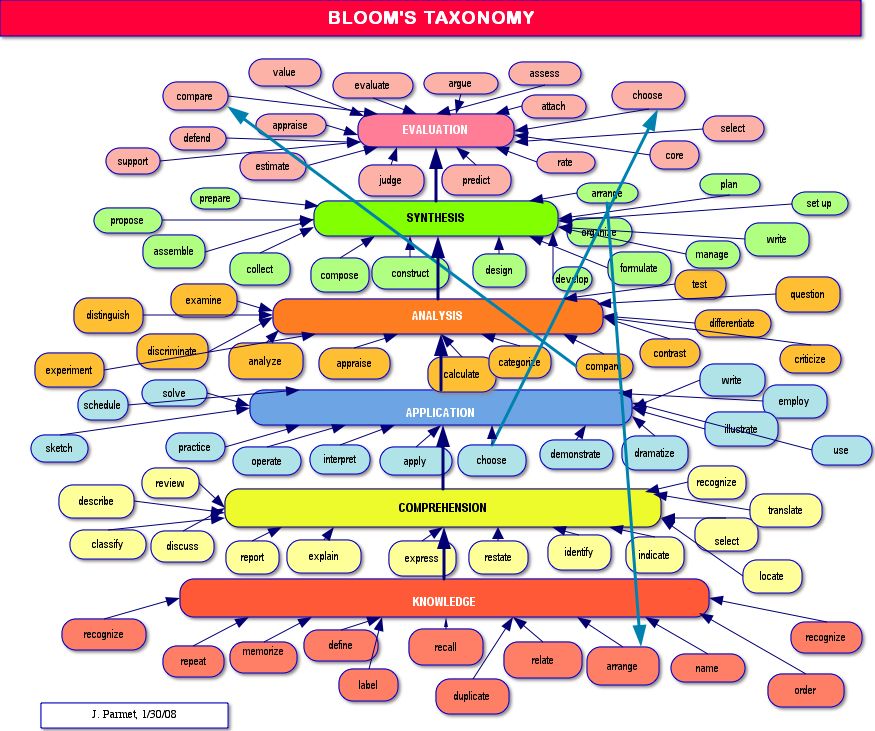
Though lists of actions associated with Bloom's taxonomy vary from source to source, below I have included eight words per category that you might use with an elementary aged child. 


As I prepared these lists, I heard in my mind, "It's not enough to know something, you need to use it!"
Teachers, mentors, parents... so many use this phrase to motivate others to do something with the their knowledge, whether they are aware of Bloom's Taxonomy or not. Perhaps it was the very same statement that led Benjamin Bloom to develop his classification system. Whatever the case may be, it is no secret that learning is a process, and levels of learning can be displayed by what we do with our new knowledge. These are the actions we want students, and even ourselves, to recognize and strive for when processing information.

You will notice that some verbs appear in more than one category. For example, "classify" can indicate both comprehension and analysis. However, in order to use it appropriate you must consider the level of learning. Consider a book about the differences between herbivores or carnivores with the following post-reading questions: 
Sally, let's look at the animal we read about on page 5. Would you classify it as an herbivore or a carnivore?
Thomas, here is a picture and description of an animal recently discovered in the rain forest. This animal has a lot of features that we read about today.  Would you would classify it as an herbivore or a carnivore? 
In the first you are simply asking, "Did they understand which animals in the book were herbivores and which were carnivores?" A higher inquiry that reaches into the analysis level will ask the learner to process what they have learned and utilize the new information. This occurs with the second objective, where by the animal to be classified was not previously presented. 

Cognitive Learning Redefined

Though Bloom's original model is still quite common and used today, while exploring other resources, you find a number of variations of the model. Regardless of how the levels are organized and defined, it is less important to consider at what level an individual question is being asked, and more important to ensure that a variety of levels are being utilized when composing reading comprehension questions.

Image Sources: 
(1.) https://sites.google.com/a/jtasd.org/dgabrielle/bloom-s-taxonomy
(2.) http://teaching.uncc.edu/resources/best-practice-articles/goals-objectives/objectives-using-bloom
(3.) http://sisltportfolio.missouri.edu/jepp54/A-Portfolio/Artifacts/BLOOMS-TAXONOMY.jpg


Putting Bloom's Taxonomy to Work

As I said above, it's not enough to know something, you need to use it. As much as that applies to students, it applies to teachers, mentors, and parents, too. Anyone can help a learner reach a higher cognitive level with the right probing questions. In fact, you do not even need to have a all-inclusive understanding of a learned concept to assist a learner in moving from a lower level to a higher one. For instance, if students were learning about ethnic foods, after reading a book about cultural cuisines, you may present your audience with the following task:
I want you to think about the foods you enjoy in your home, particularly for special occasions and holidays. Using the knowledge you just gained from the book, and your knowledge of your own family, let's organize some of our favorite foods according to ethic origins.  
In this case, organize is pushing the students in to the synthesis level, even though I as the a teacher do not know what foods the students may present. They may in fact all tell me hot dogs/American, though it is quite likely that something such as baklava/Greek or tamales/Mexican could be come up. To help students reach that level, it may be necessary to probe with a question such as:
What do you eat at home that similar to what we read about in our book?
Questions such as these, take the students to the analysis level, one step below categorizing at the synthesis level, because they are comparing and contrasting what they know with what they just learned.

Taking a Closer Look

Gooney Bird Greene by Lois Lowry is an excellent children's book for putting Bloom's Taxonomy to work. It is the story of an eclectic 2nd Grade girl who captivates her classmates in fantastical tales and in turn teaches them the keys to great story telling. She engages them with her adventures by stressing the stories are "absolutely true" and interjecting "suddenly" whenever she wants to draw her audience in.

Before reading this story aloud to a group of 2nd Grade students, you may ask the following pre-reading questions:

  1. Does anyone know the story of Gooney Bird Greene? (Knowledge)
  2. Looking at the book, how would you describe the girl on the cover? (Comprehension)
  3. Gooney Bird is a 2nd grader who likes to tell stories. How do you think we can apply what we are about to read to ourselves? (Application)
The first question will reveal if any are already familiar with the story.

The next question gets the students thinking about the main character. In the first paragraph of the book we learn that Gooney Bird is a new student, transferring into the school in October. By asking the students how they would describe her, you are putting them in the same position as her new classmates, observing her peculiar way of dress and forming a first impression. This not only shows how well they comprehend what they see on the cover and there ability to put it to words, but also sets them up for a greater comprehension of  what her classmates thought the day she walked into the class.

With the third question, you are informing the students that she is one of them, with the intent that they might consider applying some of Gooney Bird's skills to their own story telling,. 

Chapter 3 ends with the following:
Excerpt from Gooney Bird Green (Lowry, 2002, p.34)
At the conclusion of this chapter, you could ask students the following post-reading questions:
  1. Jason, can you identify the characters in the story so far? (Knowledge)
  2. Tom, how would you describe the teacher's role in this story? (Comprehension)
  3. Shawn, how can we use what we leaned from Gooney Bird so far? (Application)
  4. Sally, what is making Gooney Birds stories different and interesting? (Analysis)
  5. Can someone tell me how to modify a story to make them more like Gooney Bird's? (Synthesis)
  6. Gracey, can you predict how the class will respond to Gooney Bird's next story? (Evaluation)
These questions are of course just a sampling of the many questions you could ask. Depending on the story or text read, you may have several questions in one level of the taxonomy and just a few in the others. Again remember, what is important is that learners are presented with a variety of pre- and post-reading questions that assist them in processing the information and utilizing it beyond the knowledge level. 


Internet Resources for Applying Bloom's Taxonomy 

A quick Google search revealed for me 'About 109,000 results in 0.22 seconds'. That's quite a bit to sift through! Below are several links that deal with the application of Bloom's Taxonomy in a teaching setting.

A Blooming Butterfly Bloom’s Taxonomy Poster for Elementary Teachers

Bloom's Digital Taxonomy by Andrew Churches At Educational Origami, you'll find a variety of PDFs that apply Bloom's Taxonomy to various learning situations.

Bloom's Revised Taxonomy A variety of resources for putting Bloom's Taxonomy to use in the classroom.

"Bloom's Taxonomy - An Overview" and "Bloom's Taxonomy - Designing Activities" Interactive tutorials from Colorado Community Colleges Online

Bloom's Taxonomy Verbs A simple printable list of verbs that allign with Bloom's Taxonomy is available from TeacherVision

Sample Questions and potential activities and products utilizing Bloom's Taxonomy 

Taxonomy for Learning, Teaching, and Assessing A mouse-over stepped diagram that integrates Bloom's Taxonomy with the Factual, Conceptual, Procedural, and Metacognitive levels of learning. Prepared by Rex Heer, Iowa State University's Center for Excellence in Learning and Teaching.

Writing Objectives Using Bloom's Taxonomy from the Center for Teaching and Learning. This is a clean, straight forward presentation of four interpretations of Bloom's taxonomy that you can use for writing objectives as well as pre- and post-reading questions.

(Links last updated July 31, 2011)


References:

Atherton, J. S. (2005). Learning and teaching: Bloom's taxonomy. Retrieved from http://www.learningandteaching.info/learning/bloomtax.htm

Coles, R. (1995). The story of Ruby Bridges. New York, NY: Scholastic.

Krathwohl, D. (2002). A revision of Bloom's taxonomy: An overview. Theory Into Practice, 41(4), 212-218. Retrieved from http://www.unco.edu/cetl/sir/stating_outcome/documents/Krathwohl.pdf

Lowry, L. (2002). Gooney Bird Greene. New York, NY: Random House.

Schmittroth, L., &  Rosteck, M.K. (2000). American revolution: biographies. S. McConnell, (Ed.). Detroit, MI: U-X-L.

Slavin, R. E. (2009). Educational psychology: Theory and practice (9th ed.). Boston, MA: Pearson/Merrill.

Post ID: WGU REAT11